
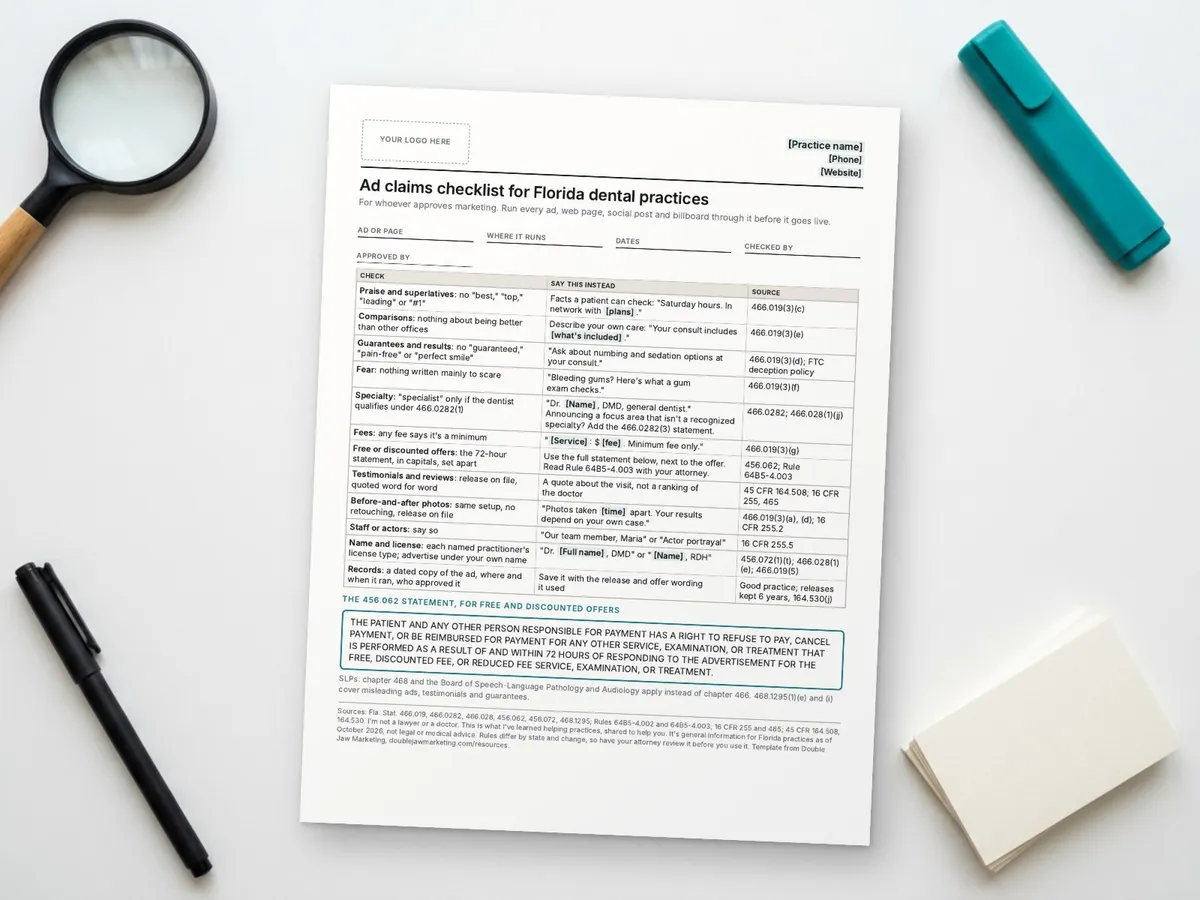
Ad claims checklist: what you can say in dental ads in Florida
By Blake Hickey, founder of Double Jaw Marketing. For practice owners, office managers and marketing staff. Updated October 17, 2026.
Most of what makes a great dental ad is also what Florida's rules ask for: real facts a patient can check, clear prices, the right name on it and your own patients' real stories. The checklist below runs any ad, web page, social post or billboard through the same twelve checks before it goes live.
Each item has what to check, a line you can use instead, and the rule behind it, so you can see the source for yourself.
Claims about you: praise, comparisons and results
Fla. Stat. 466.019 defines a dental advertisement as a representation "disseminated in any manner or by any means" to solicit patients, and lists websites and social media in the definition. Subsection (3) says an ad may not contain a false, fraudulent, misleading or deceptive statement, including one that:
- "Contains misrepresentations of fact" (3)(a)
- Makes "only a partial disclosure of relevant facts" in context (3)(b)
- "Contains laudatory statements about the dentist or group of dentists" (3)(c)
- "Is intended or is likely to create false, unjustified expectations of favorable results" (3)(d)
- "Relates to the quality of dental services provided as compared to other available dental services" (3)(e)
- "Is intended or is likely to appeal primarily to a layperson's fears" (3)(f)
- "Contains fee information without a disclaimer that such is a minimum fee only" (3)(g)
The good news: the strongest ads are usually the factual ones. Hours, location, insurance you take, what happens at the first visit and who the patient will see are all things a person can check, and they answer the questions people actually have.
| Instead of | Try |
|---|---|
| "The best dentist in [City]" | "Family dentistry in [City], with Saturday hours." |
| "Better care than the chains" | "Your first visit includes [what's included]." |
| "Pain-free dentistry, guaranteed" | "Nervous about the dentist? Ask about numbing and sedation options." |
| "A perfect smile in one visit" | "What veneers involve, how many visits it usually takes and what affects the cost." |
| "Don't wait until you lose your teeth" | "Bleeding gums? Here's what a gum exam checks and how to book one." |
The FTC's Policy Statement on Deception applies to every business, practices included, and looks at the net impression of the whole ad, not just its literal words.
Specialty claims
Fla. Stat. 466.0282(1) limits who may present themselves as a specialist: dentists who completed an ADA and Commission on Dental Accreditation approved specialty program and are eligible for or hold diplomate status from a recognized national specialty board, or who have held themselves out as a specialist in a recognized specialty since December 31, 1964. Orthodontists and oral surgeons who meet that standard can say so.
A dentist without those credentials may still announce a practice emphasis, as long as the ad includes this statement in capitals or another clearly distinguishable form:
"[NAME OF ANNOUNCED AREA OF DENTAL PRACTICE] IS NOT RECOGNIZED AS A SPECIALTY AREA BY THE AMERICAN DENTAL ASSOCIATION OR THE FLORIDA BOARD OF DENTISTRY."
If the ad mentions an organization that recognizes that area, it also needs a second statement that the organization "IS NOT RECOGNIZED AS A BONA FIDE SPECIALTY ACCREDITING ORGANIZATION BY THE AMERICAN DENTAL ASSOCIATION OR THE FLORIDA BOARD OF DENTISTRY." Advertising specialty services in violation of the chapter is grounds for discipline under 466.028(1)(jj).
Fees, free and discounted offers
Any fee in a dental ad needs a disclaimer that it's a minimum fee only (466.019(3)(g)). Any ad for a free, discounted or reduced-fee service, exam or treatment also needs the statement in Fla. Stat. 456.062, "in capital letters clearly distinguishable from the rest of the text":
"THE PATIENT AND ANY OTHER PERSON RESPONSIBLE FOR PAYMENT HAS A RIGHT TO REFUSE TO PAY, CANCEL PAYMENT, OR BE REIMBURSED FOR PAYMENT FOR ANY OTHER SERVICE, EXAMINATION, OR TREATMENT THAT IS PERFORMED AS A RESULT OF AND WITHIN 72 HOURS OF RESPONDING TO THE ADVERTISEMENT FOR THE FREE, DISCOUNTED FEE, OR REDUCED FEE SERVICE, EXAMINATION, OR TREATMENT."
Put it next to the offer, on the web page or printed piece where the offer appears. If a short ad can't hold it, keep the offer itself on your website with the statement, and keep "free" out of the short ad.
The Board of Dentistry also has a rule on this, Rule 64B5-4.003, Advertisement of Fees and Discounted Services. Its text is posted as a Word file on the state's rules site, so read the current version with your attorney before you run a special or a membership plan discount.
Testimonials, photos, staff and actors
- Testimonials and reviews. Get the patient's signed release, quote them word for word, and pick quotes about the visit rather than rankings of the doctor. The FTC treats reviews featured in ads as testimonials. The testimonials, photos and patient permission guide covers it, with a release template.
- Before-and-after photos. Same setup both times, no retouching, the time between photos and a line on what patients can generally expect. See the before-and-after photo standard.
- Staff and actors. Under 16 CFR 255.5, a connection the audience wouldn't expect "must be disclosed clearly and conspicuously." "Our team member, Maria" or "Actor portrayal" does it.
Name and license info
Fla. Stat. 456.072(1)(t) says "Any advertisement for health care services naming the practitioner must identify the type of license the practitioner holds." That covers every named person: the dentist, a hygienist, a speech-language pathologist. 466.028(1)(e) makes "advertising, practicing, or attempting to practice under a name other than one's own" grounds for discipline, and 466.019(5) lets dentists use D.D.S. and D.M.D. interchangeably.
The Board's advertising rule, Rule 64B5-4.002, was amended effective September 24, 2026, after a proposed amendment whose stated purpose was to "require disclosure of the full name of the licensee in the advertisement." The final text is posted as a Word file, so check it with your attorney. Using each dentist's full name with their degree on every ad is an easy way to cover it.
"Dr. [Full name], DMD"
"[Full name], RDH, dental hygienist"
Keeping records
I didn't find a retention period for dental ads in 466.019 or 456.062, and the Board's current rule text is in a Word file, so ask your attorney how long to keep them. Keeping a dated copy of every ad is a good habit either way: what ran, where, the dates, who approved it, and the release and offer wording it used. HIPAA separately requires keeping signed authorizations for six years from the date of creation or the date they were last in effect, whichever is later (45 CFR 164.530(j)).
A note for SLP practices
Speech-language pathologists are licensed under part I of chapter 468 and the Board of Speech-Language Pathology and Audiology, not chapter 466. Fla. Stat. 468.1295(1)(e) covers advertising that is "fraudulent, false, deceptive, or misleading in form or content," and (1)(i) covers advertising matter, testimonials and guarantees that are misleading, deceiving or untruthful. The 456.072 license type rule applies to SLPs too. 456.062's list of covered chapters includes chapter 466 but not chapter 468, so SLP practices should ask their attorney which disclosures fit a free screening offer.
I'll check your ads and website against Florida's rules
If you want this finished without pulling your team off the phones, this is work I do:
- Review your ads, website and social posts with this checklist
- Rewrite claims into facts patients can check
- Add the right disclosures to specials and specialty pages
- Hand you a marked-up list for your attorney to approve
Start with a Method Review: a free 15-minute call with Blake by phone or Zoom. You get a written Method Plan with the first fixes in order, yours to keep whether we work together or not.
Marketing help only. Not legal or medical advice. No results are guaranteed.
Common questions
Can a Florida dentist say "best dentist" in an ad?
No. Fla. Stat. 466.019(3)(c) bars laudatory statements about the dentist or group of dentists. Use facts a patient can check instead, like hours, location and insurance accepted.
What is the 72-hour statement in Florida dental ads?
It's the statement Fla. Stat. 456.062 requires in any ad for a free, discounted or reduced-fee service, exam or treatment, in capital letters clearly distinguishable from the rest of the text. It tells patients they can refuse to pay for other services performed within 72 hours of responding to the ad.
Can a general dentist advertise as a cosmetic dentistry specialist in Florida?
Only dentists who meet 466.0282(1) may present themselves as specialists. A dentist may announce a practice emphasis if the ad includes the 466.0282(3) statement that the area isn't recognized as a specialty by the ADA or the Florida Board of Dentistry.
Do Florida dental ads need the dentist's license info?
Fla. Stat. 456.072(1)(t) requires any ad naming a practitioner to identify the type of license they hold. The Board's rule was amended in 2026 after a proposal to require the licensee's full name, so use each dentist's full name and degree.
How long should we keep copies of our ads?
I didn't find a retention period in 466.019 or 456.062, so ask your attorney. Keeping a dated copy of every ad, with who approved it, is a good habit. HIPAA requires keeping signed patient authorizations six years.
Claims and sources
Checked October 17, 2026. Rules and platform settings change, so check the source before you rely on it.
- Dental ad definition; misrepresentation; partial disclosure; laudatory; unjustified expectations; comparisons; fear; minimum fee; D.D.S. and D.M.D.: Fla. Stat. 466.019 (2026 Florida Statutes)
- Who may advertise as a specialist; practice emphasis and organization statements: Fla. Stat. 466.0282 (2026 Florida Statutes)
- Discipline for advertising under another name and improper specialty advertising: Fla. Stat. 466.028 (2026 Florida Statutes)
- 72-hour statement for free and discounted offers; covered chapters: Fla. Stat. 456.062 (2026 Florida Statutes)
- Ads naming a practitioner must identify license type: Fla. Stat. 456.072(1)(t) (2026 Florida Statutes)
- Board rule on fees and discounted services: Rule 64B5-4.003, Florida Administrative Code
- Board advertising rule, amended effective September 24, 2026: Rule 64B5-4.002, Florida Administrative Code
- Proposed amendment to require the licensee's full name: Florida Administrative Register notice 31090457
- Deception standard and net impression: FTC Policy Statement on Deception (1983)
- Endorsements, typical results and material connections: eCFR 16 CFR Part 255
- Reviews in ads become testimonials: FTC: Consumer Reviews and Testimonials Rule, questions and answers
- Authorization to use patient information in marketing: eCFR 45 CFR 164.508
- Keep documentation six years: eCFR 45 CFR 164.530(j)
- Board of Speech-Language Pathology and Audiology: Fla. Stat. 468.1135
- SLP discipline for misleading advertising, testimonials or guarantees: Fla. Stat. 468.1295 (2026 Florida Statutes)