By Blake Hickey, founder of Double Jaw Marketing. For practice owners, office managers and whoever answers new inquiries. Updated October 17, 2026.
Someone fills out your website form at 9 p.m. or calls while the front desk is with a patient. A short, planned set of follow-ups makes sure every inquiry gets an answer and nobody gets buried in messages.
Below are four messages in text and email versions, the consent you need before texting, and the federal and Florida rules that sit behind them. Load them into your CRM or texting tool and set them to fire only on new inquiries.
The four follow-ups
When
Text
Email subject
First 5 minutes
Thanks, who you are, a way to book
We got your message
Day 1
A friendly nudge with the booking link
A time that works for you
Day 3
Any questions before you book?
Questions before your visit?
Closing the loop
I'll stop messaging; here's how to reach us
Should I close your request?
The full wording is on the printable sheet. Each text ends with "Reply STOP to opt out." Each email carries your practice name, postal address and an unsubscribe link. None of them mention a diagnosis, a procedure or insurance details, because texts and email previews can show up on lock screens and shared devices.
If the person called and you're following up a missed call, the same sequence works. Stop the sequence the moment they book, reply or opt out.
Consent before you text
Under the federal TCPA rules, calls and texts that introduce an advertisement or count as telemarketing, sent with an autodialer or prerecorded voice to a cell phone, need the person's prior express written consent (47 CFR 64.1200(a)(2)). The rule defines that consent as a signed written agreement that clearly authorizes those messages and lists the phone number; electronic signatures count where federal or state contract law recognizes them (64.1200(f)(9)).
The easiest place to get consent is the form itself: a checkbox that isn't pre-checked and isn't required to submit. Here's a starting point for your attorney:
"I agree that [Practice name] may contact me by text and phone at the number above, including with automated technology, about my inquiry and appointments. Consent is not a condition of purchase. Message and data rates may apply. Reply STOP to opt out."
Florida's Telephone Solicitation Act
Florida's version is Fla. Stat. 501.059, and its definition of a telephonic sales call includes text messages. Under 501.059(8)(a), an unsolicited telephonic sales call that uses "an automated system for the selection and dialing of telephone numbers" or a recorded message needs the called party's prior express written consent. Florida's definition of that consent requires the person's signature, the phone number, and a clear disclosure that they don't have to sign as a condition of buying anything.
The Legislature amended the statute in 2023 (CS/CS/HB 761, chapter 2023-150, effective May 25, 2023). As the statute reads now, before someone can sue over text message solicitations they must reply "STOP" to the number that texted them, and the sender has 15 days to stop (501.059(10)(c)).
Whether a reply to someone who just asked you to contact them counts as "unsolicited" is a question for your attorney; 501.059(1)(k) excludes calls made in response to an express request. Getting written consent on the form avoids relying on that.
STOP replies and quiet hours
The FCC's rule says people may revoke consent by any reasonable means, including replying with words like STOP, and that revocations must be honored within 10 business days (47 CFR 64.1200(a)(10)). One confirmation text that only confirms the opt-out is allowed (64.1200(a)(12)). Set your texting tool to stop immediately and log the opt-out.
Florida's 501.059 doesn't set quiet hours in its current text. The federal rule bars telephone solicitations to residential subscribers before 8 a.m. or after 9 p.m. in the called party's local time (64.1200(c)(1)). A separate Florida law for commercial telephone sellers, Fla. Stat. 501.616(6), limits calls to 8 a.m. to 8 p.m. and three calls in 24 hours; ask your attorney whether it reaches your practice. A simple house rule covers both: send between 8 a.m. and 8 p.m. local time.
Email basics under CAN-SPAM
The FTC's CAN-SPAM compliance guide lists the requirements for commercial email: accurate header and from information, a subject line that reflects the content, identifying the message as an ad, a valid physical postal address, a clear way to opt out, and honoring opt-outs within 10 business days. Hiring a vendor to send doesn't move the responsibility off you. For email with health details, HHS's FAQ on email describes the safeguards, like checking the address and limiting what's in the message.
Print for your team
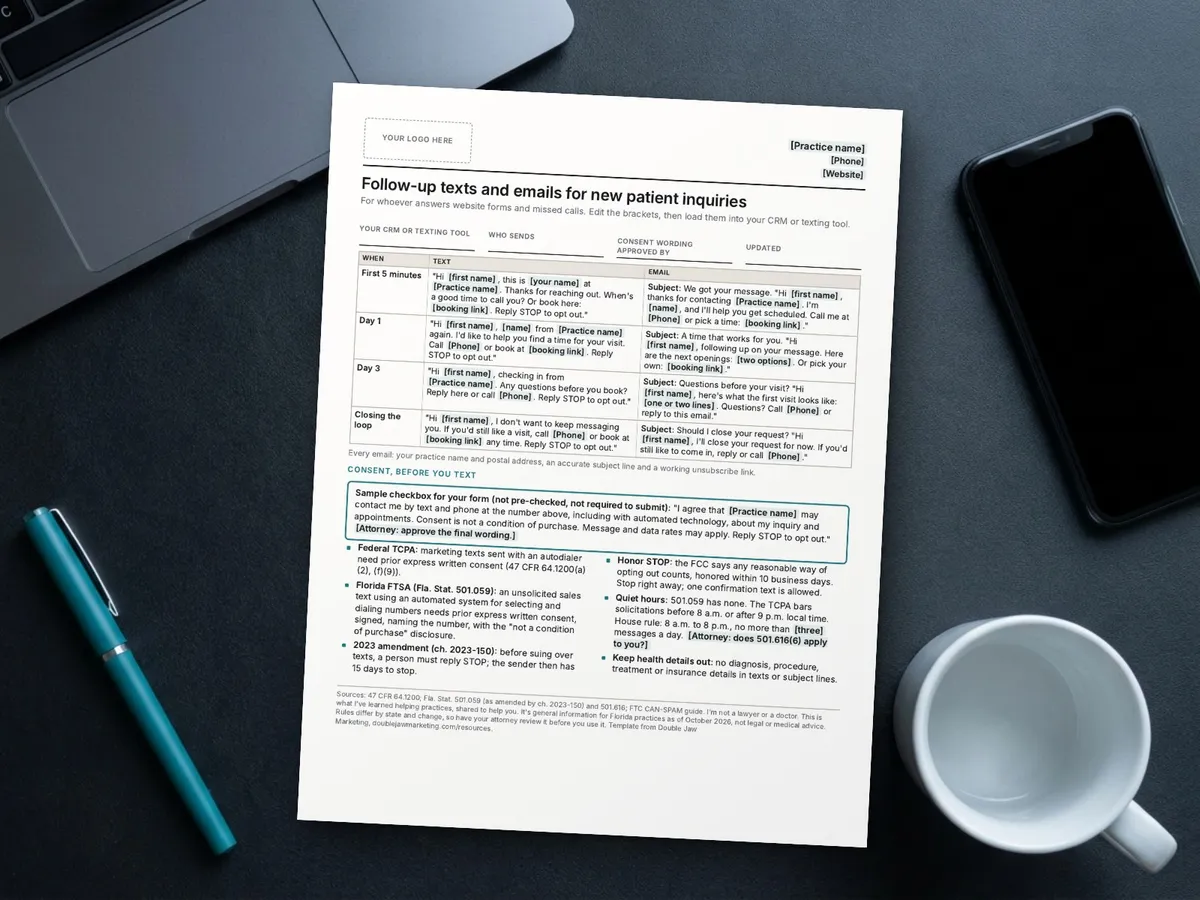
The follow-up message sheet
All four texts and emails, a sample consent checkbox and the rules in one box. Put your logo in the box, print it, or copy the text into your CRM or texting tool and make it your own.
Print it, or choose Save as PDF in the print window.
Paste the text into Word, Google Docs or your AI tool and make it your own. To print, press Ctrl+P (Cmd+P on a Mac). Only the sheet prints, on US Letter paper.
Email me the full PDF
The PDF of this sheet, ready to brand with your logo. It's free, and we send it by email.
We'll email you the PDF and one follow-up. Unsubscribe anytime. Privacy policy
Your logo here
[Practice name][Phone][Website]
Follow-up texts and emails for new patient inquiries
For whoever answers website forms and missed calls. Edit the brackets, then load them into your CRM or texting tool.
Your CRM or texting toolWho sendsConsent wording approved byUpdated
When
Text
Email
First 5 minutes
"Hi [first name], this is [your name] at [Practice name]. Thanks for reaching out. When's a good time to call you? Or book here: [booking link]. Reply STOP to opt out."
Subject: We got your message. "Hi [first name], thanks for contacting [Practice name]. I'm [name], and I'll help you get scheduled. Call me at [Phone] or pick a time: [booking link]."
Day 1
"Hi [first name], [name] from [Practice name] again. I'd like to help you find a time for your visit. Call [Phone] or book at [booking link]. Reply STOP to opt out."
Subject: A time that works for you. "Hi [first name], following up on your message. Here are the next openings: [two options]. Or pick your own: [booking link]."
Day 3
"Hi [first name], checking in from [Practice name]. Any questions before you book? Reply here or call [Phone]. Reply STOP to opt out."
Subject: Questions before your visit? "Hi [first name], here's what the first visit looks like: [one or two lines]. Questions? Call [Phone] or reply to this email."
Closing the loop
"Hi [first name], I don't want to keep messaging you. If you'd still like a visit, call [Phone] or book at [booking link] any time. Reply STOP to opt out."
Subject: Should I close your request? "Hi [first name], I'll close your request for now. If you'd still like to come in, reply or call [Phone]."
Every email: your practice name and postal address, an accurate subject line and a working unsubscribe link.
Consent, before you text
Sample checkbox for your form (not pre-checked, not required to submit): "I agree that [Practice name] may contact me by text and phone at the number above, including with automated technology, about my inquiry and appointments. Consent is not a condition of purchase. Message and data rates may apply. Reply STOP to opt out." [Attorney: approve the final wording.]
Federal TCPA: marketing texts sent with an autodialer need prior express written consent (47 CFR 64.1200(a)(2), (f)(9)).
Florida FTSA (Fla. Stat. 501.059): an unsolicited sales text using an automated system for selecting and dialing numbers needs prior express written consent, signed, naming the number, with the "not a condition of purchase" disclosure.
2023 amendment (ch. 2023-150): before suing over texts, a person must reply STOP; the sender then has 15 days to stop.
Honor STOP: the FCC says any reasonable way of opting out counts, honored within 10 business days. Stop right away; one confirmation text is allowed.
Quiet hours: 501.059 has none. The TCPA bars solicitations before 8 a.m. or after 9 p.m. local time. House rule: 8 a.m. to 8 p.m., no more than [three] messages a day. [Attorney: does 501.616(6) apply to you?]
Keep health details out: no diagnosis, procedure, treatment or insurance details in texts or subject lines.
Sources: 47 CFR 64.1200; Fla. Stat. 501.059 (as amended by ch. 2023-150) and 501.616; FTC CAN-SPAM guide. I'm not a lawyer or a doctor. This is what I've learned helping practices, shared to help you. It's general information for Florida practices as of October 2026, not legal or medical advice. Rules differ by state and change, so have your attorney review it before you use it. Template from Double Jaw Marketing, doublejawmarketing.com/resources.
See the text version
[Your logo here]
**[Practice name]** | [Phone] | [Website]

# Follow-up texts and emails for new patient inquiries

For whoever answers website forms and missed calls. Edit the brackets, then load them into your CRM or texting tool.

Your CRM or texting tool: ______________________
Who sends: ______________________
Consent wording approved by: ______________________
Updated: ______________________

| When | Text | Email |
|---|---|---|
| First 5 minutes | "Hi [first name], this is [your name] at [Practice name]. Thanks for reaching out. When's a good time to call you? Or book here: [booking link]. Reply STOP to opt out." | **Subject:** We got your message. "Hi [first name], thanks for contacting [Practice name]. I'm [name], and I'll help you get scheduled. Call me at [Phone] or pick a time: [booking link]." |
| Day 1 | "Hi [first name], [name] from [Practice name] again. I'd like to help you find a time for your visit. Call [Phone] or book at [booking link]. Reply STOP to opt out." | **Subject:** A time that works for you. "Hi [first name], following up on your message. Here are the next openings: [two options]. Or pick your own: [booking link]." |
| Day 3 | "Hi [first name], checking in from [Practice name]. Any questions before you book? Reply here or call [Phone]. Reply STOP to opt out." | **Subject:** Questions before your visit? "Hi [first name], here's what the first visit looks like: [one or two lines]. Questions? Call [Phone] or reply to this email." |
| Closing the loop | "Hi [first name], I don't want to keep messaging you. If you'd still like a visit, call [Phone] or book at [booking link] any time. Reply STOP to opt out." | **Subject:** Should I close your request? "Hi [first name], I'll close your request for now. If you'd still like to come in, reply or call [Phone]." |

Every email: your practice name and postal address, an accurate subject line and a working unsubscribe link.

## Consent, before you text

**Sample checkbox for your form (not pre-checked, not required to submit):** "I agree that [Practice name] may contact me by text and phone at the number above, including with automated technology, about my inquiry and appointments. Consent is not a condition of purchase. Message and data rates may apply. Reply STOP to opt out." [Attorney: approve the final wording.]

- **Federal TCPA:** marketing texts sent with an autodialer need prior express written consent (47 CFR 64.1200(a)(2), (f)(9)).
- **Florida FTSA (Fla. Stat. 501.059):** an unsolicited sales text using an automated system for selecting and dialing numbers needs prior express written consent, signed, naming the number, with the "not a condition of purchase" disclosure.
- **2023 amendment (ch. 2023-150):** before suing over texts, a person must reply STOP; the sender then has 15 days to stop.

- **Honor STOP:** the FCC says any reasonable way of opting out counts, honored within 10 business days. Stop right away; one confirmation text is allowed.
- **Quiet hours:** 501.059 has none. The TCPA bars solicitations before 8 a.m. or after 9 p.m. local time. House rule: 8 a.m. to 8 p.m., no more than [three] messages a day. [Attorney: does 501.616(6) apply to you?]
- **Keep health details out:** no diagnosis, procedure, treatment or insurance details in texts or subject lines.

---
Sources: 47 CFR 64.1200; Fla. Stat. 501.059 (as amended by ch. 2023-150) and 501.616; FTC CAN-SPAM guide. I'm not a lawyer or a doctor. This is what I've learned helping practices, shared to help you. It's general information for Florida practices as of October 2026, not legal or medical advice. Rules differ by state and change, so have your attorney review it before you use it. Template from Double Jaw Marketing, doublejawmarketing.com/resources.
Prints on US Letter. Not legal advice; have your attorney approve your consent wording before you send a single text.
Want this done for your practice?
I'll set up your new patient follow-up
If you want this finished without pulling your team off the phones, this is work I do:
Write the messages in your practice's voice
Build the sequence in your own CRM or texting tool, firing only on new inquiries
Add the consent checkbox to your website forms for your attorney to approve
Track which inquiries book, by source
Start with a Method Review: a free 15-minute call with Blake by phone or Zoom. You get a written Method Plan with the first fixes in order, yours to keep whether we work together or not.
Marketing help only. Not legal or medical advice. No results are guaranteed.
Common questions
Do we need written consent to text new patient inquiries?
For marketing texts sent with automated technology, the federal TCPA rule and Florida's 501.059 require prior express written consent. Add a consent checkbox to your form and have your attorney approve the wording.
What changed in Florida's telephone solicitation law in 2023?
Chapter 2023-150 amended 501.059. As the statute reads now, a person must reply STOP to text solicitations before suing, and the sender has 15 days to stop.
What hours can a practice send texts in Florida?
501.059 has no quiet hours in its current text. The federal rule bars solicitations before 8 a.m. or after 9 p.m. local time, and 501.616 sets 8 a.m. to 8 p.m. for commercial telephone sellers. Sending between 8 a.m. and 8 p.m. covers both.
What does every follow-up email need?
Accurate from and subject lines, your physical postal address and a working unsubscribe link, with opt-outs honored within 10 business days.
Claims and sources
Checked October 17, 2026. Rules and platform settings change, so check the source before you rely on it.
TCPA prior express written consent, revocation within 10 business days, confirmation text, 8 a.m. to 9 p.m.:eCFR 47 CFR 64.1200
Blake Hickey has worked in marketing since 2006 and runs Hickey Media LLC in Jupiter, Florida. He is the marketing director at an IT and cybersecurity company, hosts and produces The Florida Bar Business Law Section's continuing legal education series on lawyer advertising compliance, and plans the campaigns, shoots the video and designs the ads himself. He writes from accounts he has run, not from theory. Nothing here is legal advice, and no result is promised.