Elastics wear chart for orthodontic patients
By Blake Hickey, founder of Double Jaw Marketing. For orthodontists, clinical teams, and the patients and parents they send home with elastics. Updated October 17, 2026.
Kids with elastics forget where they go. That's normal. A lot of offices sketch the pattern on the back of the elastics bag, and by Thursday it's smudged and hard to read.
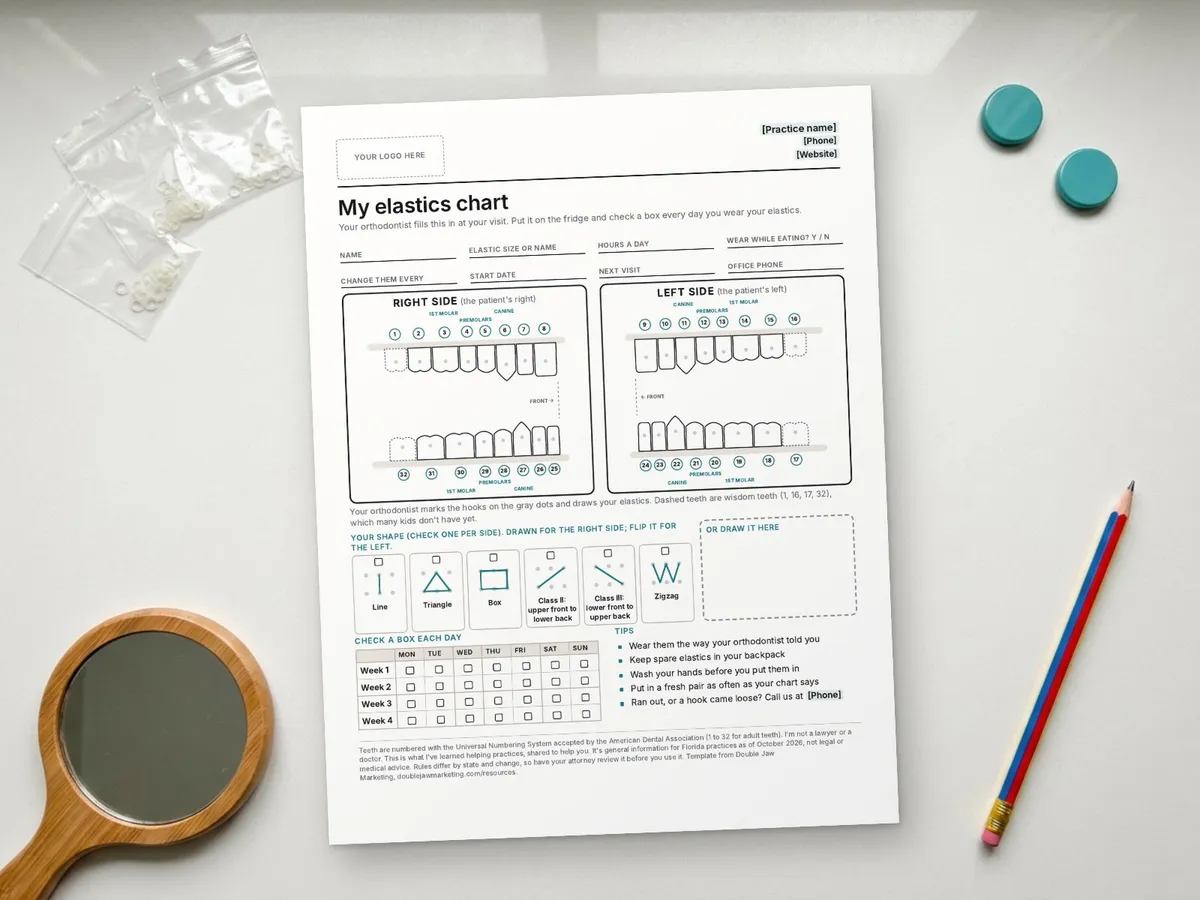
This is a one-page fridge chart the orthodontist fills in at the appointment: a numbered drawing of each side of the mouth to mark the hooks and draw the elastics, the size and schedule, and a four-week calendar to check off. Put your logo on it and it goes home with every patient.
How to use it at the appointment
- Fill in the top. Name, elastic size or name, hours a day, whether to wear them while eating, how often to change them, the start date, the next visit and your office phone.
- Mark the hooks. Each tooth has a light gray dot. Fill in the dots where the hooks are, on the right side and the left side.
- Draw the elastics. Connect the dots in the shape you prescribed, and check the matching shape below the diagrams. If it's a custom pattern, draw it in the box.
- Hand it over. Show the patient and parent the drawing, and ask them to put it on the fridge.
The two diagrams sit side by side the way you'd see the mouth facing the patient: the patient's right side on the left of the page, the patient's left side on the right, with the front of the mouth toward the middle.
How the teeth are numbered
The chart uses the Universal Numbering System, the 1 to 32 system the American Dental Association accepted for adult teeth. The ADA Universal Tooth Designation System, as published in HL7's terminology, starts at 1 with the upper right third molar and runs across the upper arch to 16, the upper left third molar, then from 17, the lower left third molar, across to 32, the lower right third molar. Baby teeth use the letters A to T in the same system.
| Tooth | Right side | Left side |
|---|---|---|
| Upper canine | 6 | 11 |
| Upper premolars | 4, 5 | 12, 13 |
| Upper first molar | 3 | 14 |
| Lower canine | 27 | 22 |
| Lower premolars | 28, 29 | 20, 21 |
| Lower first molar | 30 | 19 |
Those are the teeth the chart labels, since that's where elastic hooks usually go. Wisdom teeth (1, 16, 17 and 32) are drawn with a dashed line, since many younger patients don't have them yet.
At home
The tips on the chart are general on purpose: wear them the way your orthodontist told you, keep spares in your backpack, wash your hands first, put in a fresh pair as often as the chart says, and call the office if you run out or a hook comes loose. Everything specific to the patient comes from the orthodontist and goes in the boxes at the top.
The check-off calendar gives kids something to do every day, and gives you something to look at together at the next visit.
I'll design your patient handouts
If you want this finished without pulling your team off the phones, this is work I do:
- Brand this chart and your other take-home sheets for your practice
- Write them with your clinical team, in your practice's voice
- Keep the wording clear of clinical promises
Start with a Method Review: a free 15-minute call with Blake by phone or Zoom. You get a written Method Plan with the first fixes in order, yours to keep whether we work together or not.
Marketing help only. Not legal or medical advice. No results are guaranteed.
Common questions
How are teeth numbered on an elastics chart?
With the Universal Numbering System accepted by the ADA: 1 is the upper right third molar, the numbers run across the upper arch to 16, then from 17 on the lower left across to 32 on the lower right.
Which teeth do elastic hooks usually go on?
The chart labels the canines, premolars and first molars, where hooks usually go. Your orthodontist marks the exact teeth on the diagram.
Does the chart tell patients how to wear their elastics?
No. The orthodontist fills in the size, hours, schedule and shape at the visit. The tips on the chart are general reminders only.
Can our practice put its logo on the chart?
Yes. Put your logo in the box, add your practice name and phone, and print a stack for the clinic.
Claims and sources
Checked October 17, 2026. Rules and platform settings change, so check the source before you rely on it.
- Universal Numbering System, 1 to 32 starting at the upper right third molar; accepted by the ADA; letters A to T for baby teeth: HL7 Terminology: ADA Universal Tooth Designation System